- New


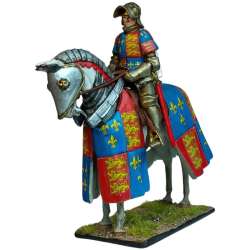
HANDCRAFTED TOY SOLDIER representing a 16th-century French heavy cavalryman from our Battle of Pavia 1525 collection. Sculpted and cast in white metal at 1:30 scale, this mounted piece is assembled and hand-painted in our workshop in Spain. Traditional craftsmanship and careful attention to detail are at the heart of every Kronprinz creation. French heavy cavalry gendarme mounted on a horse in motion. Particularly striking are the long cavalry lance with its characteristic protective rondel, the full armour and the green horse caparisons decorated with golden motifs. The ensemble has a distinctly Renaissance appearance and a strong heraldic character.
The French Gendarmerie was one of the most prominent heavy cavalry forces in Renaissance Europe. Its members, known as gendarmes, were drawn mainly from the nobility and formed an elite corps within the French royal army. Their principal role was to break enemy formations through powerful cavalry charges, using the impact of their lances and the strength of their warhorses.
During the Italian Wars, which began in the late 15th century, French gendarmes faced some of the most experienced military forces in Europe. Heavy cavalry remained a major force on the battlefield, although its effectiveness increasingly depended on coordination with infantry, artillery and firearms.
At the Battle of Pavia on 24 February 1525, French cavalry launched significant charges against the Imperial forces of Charles V. Initially, they managed to overcome parts of the opposing cavalry, but the French army's deployment and the intervention of Imperial arquebusiers changed the course of the battle. Infantry action and portable firearms played a decisive role in the Imperial victory.
The defeat was disastrous for Francis I, who was captured during the battle. The French king remained a prisoner in Spain until the signing of the Treaty of Madrid in 1526. Pavia thus became one of the most significant events of the Italian Wars and a landmark in the evolution of warfare during the 16th century.
Heavy cavalry did not disappear after Pavia, but the battle demonstrated that even the most prestigious and well-trained aristocratic forces could be vulnerable when confronted by armies capable of combining infantry, firearms and artillery effectively.
Data sheet
HANDCRAFTED TOY SOLDIER representing a 16th-century French heavy cavalryman from our Battle of Pavia 1525 collection. Sculpted and cast in white metal at 1:30 scale, this mounted piece is assembled and hand-painted in our workshop in Spain. Traditional craftsmanship and careful attention to detail are at the heart of every Kronprinz creation. French heavy cavalry gendarme mounted on a horse in motion. Particularly striking are the long cavalry lance with its characteristic protective rondel, the full armour and the green horse caparisons decorated with golden motifs. The ensemble has a distinctly Renaissance appearance and a strong heraldic character.