- New


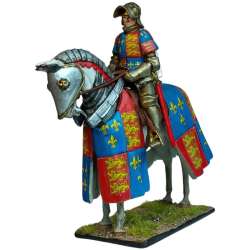
HANDCRAFTED TOY SOLDIER depicting a French heavy cavalryman of the 16th century, from our Battle of Pavia 1525 collection. Sculpted and cast in white metal at 1:30 scale, this mounted piece is carefully assembled and hand-painted in our workshop in Spain. Each creation reflects the traditional craftsmanship of Kronprinz Toy Soldiers. This sixth French gendarme has a more imposing composition than the previous ones: the rider sits upright on his horse, holding a long lance vertically. He wears full armour and a helmet with a light blue plume, complemented by elegant blue horse trappings decorated with golden fleurs-de-lis. The ensemble evokes the imagery of Renaissance French aristocratic cavalry.
The French Gendarmerie was one of the most prestigious heavy cavalry corps in Renaissance Europe. Its members, known as gendarmes, were mainly drawn from the nobility and formed an elite force serving the King of France. Their principal role was to deliver shock charges against enemy formations, making particular use of the cavalry lance.
French heraldry played an important role in representing royal and aristocratic power. The fleur-de-lis, historically associated with the French monarchy, became one of its most recognisable symbols. Its presence on banners, emblems and ornaments evoked the authority of the Crown and the identity of the kingdom.
During the Italian Wars, which began in 1494, French gendarmes fought against the armies of Europe's leading powers. Heavy cavalry remained a prestigious and formidable military force, although its effectiveness increasingly depended on coordination with infantry, artillery and firearms.
At the Battle of Pavia on 24 February 1525, French cavalry launched important charges against the Imperial forces of Charles V. Although it achieved some initial success against opposing cavalry, the intervention of Imperial arquebusiers and the coordinated action of the infantry eventually turned the battle in the Imperial army's favour.
The defeat culminated in the capture of Francis I of France, who was taken to Spain and remained a prisoner until the Treaty of Madrid in 1526. Pavia became one of the decisive episodes of the Italian Wars and a symbol of the transformation of European warfare during the 16th century.
Data sheet
HANDCRAFTED TOY SOLDIER depicting a French heavy cavalryman of the 16th century, from our Battle of Pavia 1525 collection. Sculpted and cast in white metal at 1:30 scale, this mounted piece is carefully assembled and hand-painted in our workshop in Spain. Each creation reflects the traditional craftsmanship of Kronprinz Toy Soldiers. This sixth French gendarme has a more imposing composition than the previous ones: the rider sits upright on his horse, holding a long lance vertically. He wears full armour and a helmet with a light blue plume, complemented by elegant blue horse trappings decorated with golden fleurs-de-lis. The ensemble evokes the imagery of Renaissance French aristocratic cavalry.