- New


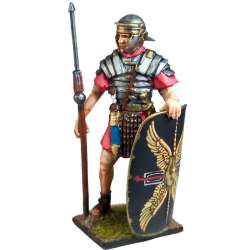
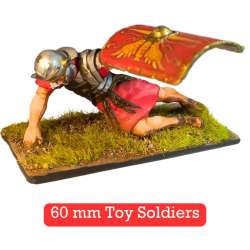
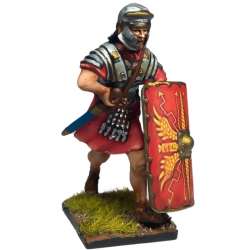
Roman legionary toy soldier equipped with the characteristic military panoply of the second half of the 1st century AD, including lorica segmentata armour and an Imperial Gallic helmet. Representing the legionaries who fought during the Year of the Four Emperors (AD 69).
From the 1st century AD onwards, Roman military equipment underwent a series of gradual changes that would shape the characteristic appearance of the legions during much of the Early Roman Empire.
This figure represents a legionary equipped with military equipment typical of the second half of the 1st century AD, similar to that worn by soldiers who fought during the civil wars of the Year of the Four Emperors (AD 69). Elements of this equipment were already in use during the Roman invasion of Britain under Emperor Claudius in AD 43.
One of the most distinctive features is the segmented armour known as lorica segmentata. Made up of articulated and overlapping metal plates, this type of armour allowed considerable freedom of movement despite being constructed from solid metal sections.
Its design also made it relatively quicker and less expensive to manufacture than the complex chainmail armour known as lorica hamata. It also provided particularly effective protection for the shoulders.
The legionary also wears an Imperial Gallic helmet, an evolution in Roman military headgear that offered improved protection to the back and sides of the neck. Its design provided greater coverage than the earlier Montefortino and Coolus helmet types.
A representation of the Roman legionary during a period of significant military transformation, when the Imperial army was developing some of the most recognisable elements of its equipment.
Data sheet
You might also like
Roman legionary toy soldier equipped with the characteristic military panoply of the second half of the 1st century AD, including lorica segmentata armour and an Imperial Gallic helmet. Representing the legionaries who fought during the Year of the Four Emperors (AD 69).